
Most teams already have AI in the editor. A completion in the IDE. A chat tab with a pasted function. That is not a pipeline. That is a person with a tool.
An AI code pipeline is the path a change takes from a laptop to production, with a model sitting in a named seat. The longer name is an artificial intelligence coding pipeline. Same path. Review. Tests. CI. Sometimes a stack-specific check. The model has a job description. A human still owns the merge.
If you searched for “artificial intelligence coding pipeline,” “AI coding pipeline,” or “how to add AI to a dev pipeline,” this is the definition that holds up after the demo week.
The path, without the model
Write down how a change ships on your team. Not the architecture diagram. The actual Friday path.
A typical small team looks like this. Someone branches from main. They open a pull request when the change is “good enough to talk about.” One other person is supposed to review. CI runs lint and tests. If the reviewer is in meetings, the PR waits. If CI is red, the author pokes it. If both are green and nobody has time, the PR still waits. Merge happens when someone is tired of seeing it.
That path already is a pipeline. It has stages, queues, and a bottleneck. The bottleneck is almost always review or merge, not typing speed.
Adding AI does not create a pipeline. It occupies a seat that was empty or overloaded. If you do not know which seat, you will sprinkle a model on every stage and call the noise “coverage.”
What “a named seat” means
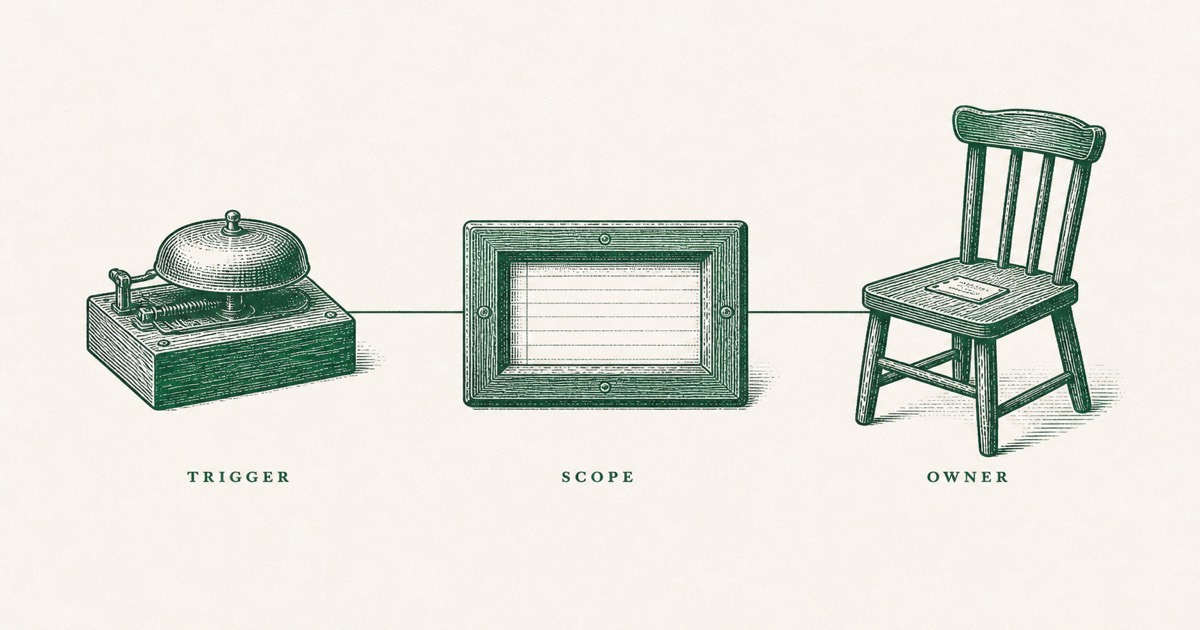
A seat has three things: a trigger, a scope, and an owner.
Trigger. When does the model run? On pull request open. On each push. On a label. On a nightly job. “Whenever someone remembers to paste the diff” is not a trigger.
Scope. What is it allowed to look at? The diff. The diff plus the two files it touches. Never “the whole repository, please find anything.” Wide scope is how you get a lecture about naming in a file nobody changed.
Owner. Who reads the output and is allowed to ignore it? If the answer is “the team,” nobody will. Pick the author, or the on-call reviewer for that repo. One name.
When those three are written down, you have an AI coding pipeline. When they are not, you have a chatbot with repository access.
A concrete week
Take a four-person product team. One repo. GitHub. PRs are the unit of work. They ship a few times a week when review keeps up.
Monday they pick the seat: first-pass review on every new PR. Scope is the diff. Owner is the author. The reviewer still does the human pass, but they start from the model’s list instead of a cold file tree.
Tuesday a PR opens that adds a rate limit to an API route. The model flags a missing test for the 429 path and a header that is read twice. The author keeps the test, drops the style nit, and asks the reviewer to look at the limit itself. Review time is twenty minutes, not an hour of “I will get to it.”
Wednesday a PR is a two-line copy change. The model says nothing useful. The author merges after CI. That is success. Silence is a valid output.
Thursday someone pastes a stack trace into chat and asks the model to “fix CI.” That is not the pipeline. That is the old habit. They put the failure back on the PR and let the named job speak, or they fix it themselves.
Friday they look at five PRs. Three had comments worth keeping. Two were noise. They tighten the scope: no comments on formatting the linter already owns. That is how a pipeline is tuned. Not by buying another tool.
Pipeline versus assistant
An assistant helps one person write. A pipeline helps the change move. Both can use the same model family. They fail in different ways.
Assistants fail in private. A bad completion dies in the buffer. A pipeline fails in public. A bad comment sits on the PR, trains the team to ignore the bot, and then the one useful comment dies with the rest.
That is why “we already use AI” is not an answer. Using it in the editor does not put a first pass on the review queue. It does not give CI a job with a budget. It does not create a merge habit.
If you want the longer version of the review seat, read add AI to your review pipeline. If your CI is where you want the model, read AI in CI for small teams. If the expensive model is burning quota exploring the tree, read save Fable 5 credits.
Where teams pretend they have one
Three patterns show up on teams that say they have an AI pipeline and do not.
The paste culture. Every engineer has a different prompt. There is no shared trigger. Quality depends on who opened the PR. That is a toolbox, not a pipeline.
The always-on lecture. A bot comments on every file in the diff, including generated code and lockfiles. After two weeks the team hides the bot. The seat is empty again.
The no-merge theater. The model is wired. CI is green. Review comments are “looks good.” The branch still sits because shipping is scary or because Friday deploys are banned without a replacement window. The model cannot fix a team that does not merge. See when AI review is noise if the comments are the reason nobody merges.
What to write down this week
You do not need a strategy doc. You need a short note in the repo, next to the contributing guide:
- Which seat the model has (review, CI, or tests — pick one).
- What triggers it.
- What it is allowed to touch.
- Who is allowed to dismiss it.
- What never blocks merge (style, speculation, “consider…”).
Then run it on one open pull request. Not a sample repo. A real change that has been waiting. Read the output with the author. Keep, discard, merge.
If that loop is useful, you have the start of an AI code pipeline. If it is not, you learned it on one PR instead of a quarter of ignored comments.